
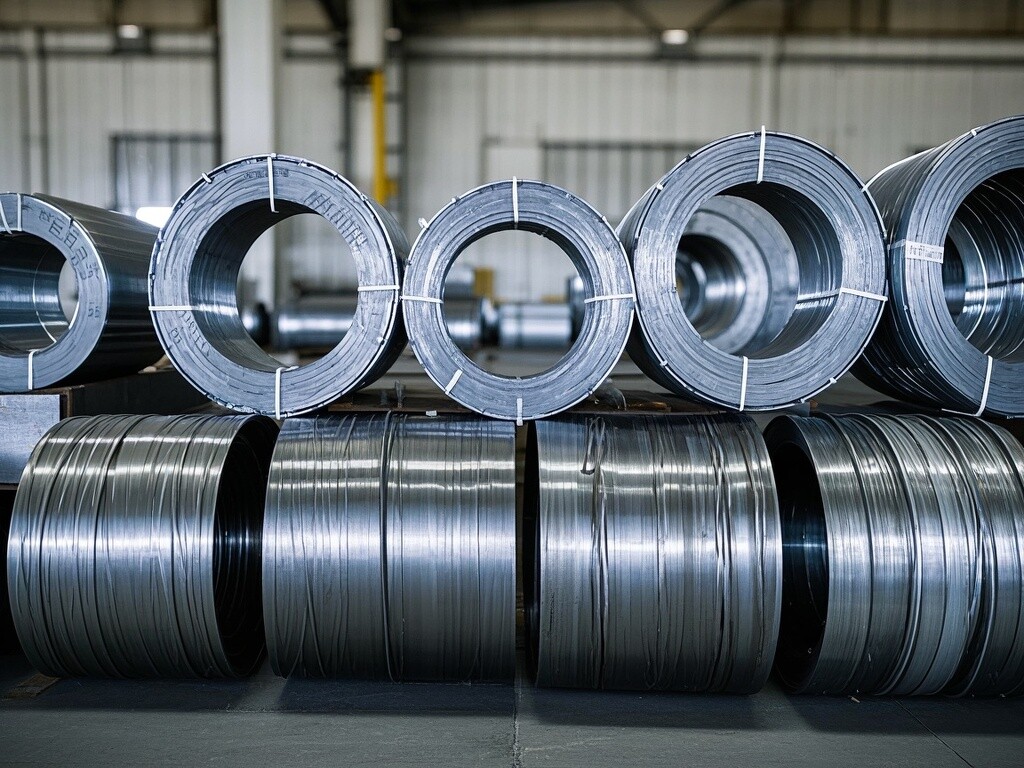
-- Scientific Selection Helps Improve Engineering Efficiency
I. Classification System: Comprehensive Definition from Composition to Process
1. Classification by Chemical Composition
Low-carbon steel wire (carbon content ≤ 0.25%): Grades such as Q195 and Q215 are characterized by high ductility and low cost, primarily used for strapping, mesh weaving, and nail manufacturing.
Medium- and high-carbon steel wire (carbon content 0.3%-0.8%): Grades include 45#, 65Mn, and 80#. They offer high strength and wear resistance and are suitable for springs, bearing rollers, and saw blades.
Stainless steel wire: 304/316L are the main grades, offering corrosion resistance and non-magnetic properties. They are used in medical devices, offshore cables, and food processing equipment.
Alloy steel wire: Grades such as 72A (manganese silicon alloy) and 82B (boron microalloyed) have tensile strengths exceeding 2000 MPa and are specifically used for tire cord and cutting wire. 2. Classification by Processing Technology
Cold-drawn steel wire: Hardened by cold drawing, with a surface finish of Ra ≤ 1.6μm and a dimensional accuracy of ±0.02mm. Typical applications: precision springs and electrode wire.
Hot-dip galvanized steel wire: Zinc coating of 60-300g/㎡, salt spray resistance of 500-2000 hours, suitable for electric fences and bridge cables.
Quenched and tempered steel wire: Heat-treated to increase strength, with a tensile strength of 1500-2000MPa. Applications: Mining wire rope and hydraulic hose reinforcement.
3. Classification by Surface Treatment
Smooth steel wire: Uncoated, with excellent conductivity, used for welding electrodes and cable cores.
Coated steel wire:
PVC/PE plastic coating: 0.4-1.2mm thick, provides weather-resistant insulation and is commonly used in outdoor protective netting and gardening supports.
Epoxy coating: Resistant to acid and alkali corrosion (pH 1-14), specifically for chemical pipeline supports and sewage treatment equipment. II. In-Depth Analysis of Application Scenarios
1. Construction Engineering
Prestressed Steel Wire: Diameter Φ4.0-12.0mm, Yield Strength ≥1860MPa. Core Applications: High-Speed Railway Sleepers and Large Bridge Beam and Slab Reinforcement.
Diamond Wire Mesh: Mesh Size 50×100mm, Tensile Strength 550N/mm². Functions: Tunnel Rock Wall Support and Mine Roadway Protection.
2. Industrial Manufacturing
Spring Steel Wire: SWP-B Grade, Fatigue Life Over 1 Million Cycles. Typical Applications: Automotive Suspension Springs and Industrial Valve Reeds.
Flux-Cored Welding Wire: ER308LSi Stainless Steel, Welds Temperature-Resistant to 800°C, Suitable for Welding Pressure Vessels and Nuclear Power Pipelines.
3. Emerging Technologies
Photovoltaic Bracket Steel Wire: Zinc-Aluminum-Magnesium Alloy Coating (Weather Resistance Three Times Higher than Pure Zinc Coating), Suitable for the Harsh Environments of Desert and Coastal PV Power Plants. Biomedical nickel-titanium wire: Shape memory effect (deformation recovery rate >95%). Core applications: Cardiovascular stents and orthodontic archwires.
III. Three Criteria for Scientific Selection
1. Environmental Adaptability
o For coastal environments with high humidity: Choose 316L stainless steel wire (chloride ion tolerance 1000 ppm) or 300g/m2 hot-dip galvanized steel wire.
o For pickling/electroplating workshops: Use PVC-coated steel wire (resistant to strong acid and alkali corrosion).
2. Mechanical Property Matching
o For high dynamic load applications (e.g., crane cables): Choose quenched and tempered steel wire (tensile strength ≥1770 MPa).
o For static structural components (e.g., building stirrups): Choose medium-carbon cold-drawn steel wire (30% lower cost, meets strength standards).
3. Lifecycle Costing
o For short-term projects: Choose low-carbon galvanized steel wire (lifespan 5-8 years, lowest overall cost).
o For permanent installations: Choose alloy steel wire with epoxy coating (lifespan >25 years, near-zero maintenance costs). IV. Jinxi Steel Technical Solutions
Customization Capabilities: Supports custom production of wires ranging from ultra-fine 0.1mm Φ to thick 20mm Φ, with zinc/coating thickness adjustable upon request.
Quality Assurance: Tensile strength test reports (compliant with ASTM A370) and salt spray test data (ISO 9227) are provided for each batch.
Successful Case Study: The Jubail Desalination Plant project in Saudi Arabia employed 316L steel wire rope (tensile strength 1770 MPa), replacing carbon steel and extending maintenance cycles to 10 years.
Please give us a message