
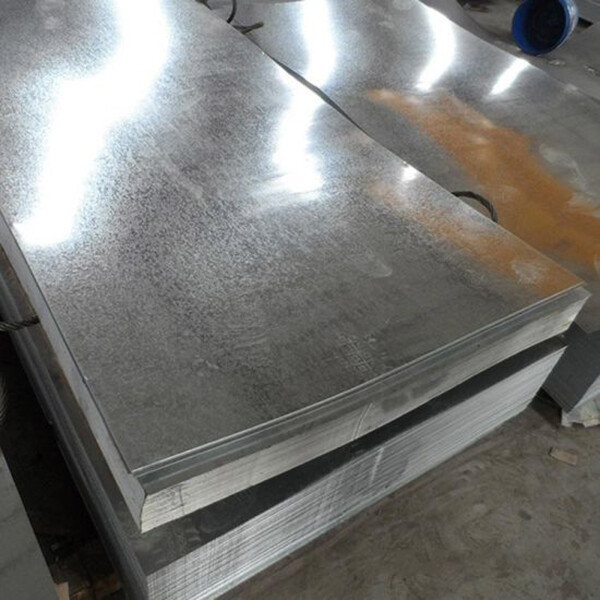
I. Classification by Processing Technology
1. Hot-Dip Galvanized Steel (HDG)
Process: The steel sheet is immersed in molten zinc (450-460°C), resulting in a zinc layer thickness typically 50-200g/㎡.
Features: Uniform zinc layer, strong adhesion, and excellent corrosion resistance (suitable for outdoor applications).
Applications: Building roofs, highway guardrails, and photovoltaic mounting systems (e.g., West African pipe piles).
2. Electrogalvanized Steel (EG)
Process: Electrolytically deposits a zinc layer with a thickness of 5-30g/㎡ and a smooth surface.
Features: High precision (controllable zinc layer thickness), suitable for complex forming.
Applications: Appliance housings (e.g., air conditioner housings), precision instrument housings (requiring fingerprint resistance).
3. Alloyed Galvanized Steel (GA)
Process: Hot-dip galvanizing followed by heating to form an alloy layer (Fe-Zn).
Features: Anti-powdering, high-temperature resistance (200°C), and excellent weldability. Applications: Automotive chassis, battery pack casings (new energy sector).
II. Classification by zinc coating thickness
1. Standard zinc coating (50-120g/m2)
Standard: Complies with national standard GB/T 2518-2019, suitable for general corrosion environments.
Applications: Indoor equipment housings, building components in dry areas.
2. Thick zinc coating (≥200g/m2)
Standard: EU EN 10346, salt spray resistance ≥1000 hours.
Applications: Beach villas, chemical plants (such as those in West African mangroves).
3. Cut-edge protection zinc coating
Process: Cold-spray zinc (zinc content ≥99.9%) on cut edges, increasing thickness by 30-50μm.
Applications: Pipe piles, steel structure joints (to prevent cut-edge corrosion).
III. Classification by application
1. Galvanized sheet for building structures
Requirements: High load-bearing capacity, weather resistance (C5 corrosion environment). Solution: 200g/㎡ zinc coating + cold-spray zinc cutting treatment, ISO 12944 certified.
2. Galvanized Sheet for Automotive Manufacturing
Requirement: Balance of lightweight and safety (e.g., new energy battery packs).
Solution: High-strength galvanized sheet (550MPa grade), achieving a 15% weight reduction while meeting crash test requirements.
3. Galvanized Sheet for Reservoirs
Requirement: Water and chemical resistance (pH 5-9).
Solution: Epoxy resin coating on the zinc layer, passing a 240-hour neutral salt spray test.
4. Galvanized Sheet for Home Appliance Exteriors
Requirement: Fingerprint and scratch resistance (e.g., outdoor air conditioner housings).
Solution: Electrogalvanized sheet + anti-fingerprint coating, combined with pearl cotton for protection (refer to a Vietnamese case).
IV. Classification by Mechanical Properties
1. Standard-Strength Galvanized Sheet
Tensile Strength: 370-450MPa, suitable for non-load-bearing structures (e.g., decorative panels). 2. High-Strength Galvanized Sheet
Tensile strength: ≥550 MPa, suitable for load-bearing structures (such as automobile chassis and building trusses).
Example: In the West African pipe pile project, 35CrMo alloy galvanized sheet has a temperature resistance of 500°C and is certified for a 30-year lifespan.
Please give us a message